
And also tested how Accra-hosted infrastructure changes the equation
Key Takeaways: Slow Ecommerce Website Ghana
- Server location affects ecommerce performance: Hosting a Ghanaian online store closer to local customers can reduce network latency compared with hosting overseas.
- Traffic spikes expose performance problems: Our test found that the difference became much more noticeable as concurrent shoppers increased.
- Mobile money adds another step to checkout: Slow website responses combined with payment confirmation delays can create a frustrating buying experience.
- Local ecommerce hosting can improve resilience: Accra-hosted infrastructure kept completing shopper sessions under loads where the internationally hosted test store struggled.
- Performance can affect sales: For ecommerce businesses, hosting performance matters most during promotions and other periods when large numbers of customers arrive at once.
Have you ever tried to check out on a Ghanaian online store and just… waited? The spinner keeps spinning, the page refreshes itself halfway through, and by the time it’s your turn to pay, you’ve talked yourself out of the purchase.
Especially during a promotion or big sale event, that wait can be the difference between a sale and an abandoned cart.
You get fed up. You leave. And the store never even finds out why.
This isn’t a one-off annoyance; it’s a recurring problem. The average Ghanaian shopper already deals with inconsistent connectivity from local telcos. Add a slow e-commerce site on top of that, and buying one discounted, cherished item can turn into a multi-minute ordeal: pages that stall, checkouts that refresh halfway through, and, if you’re paying with mobile money, a payment prompt that takes its time arriving, if it arrives at all.
None of this is good for the brand or the customer. The brand loses the trust it worked to build, and the sale it was counting on evaporates. In Ghana, word of mouth travels fast, and a bad checkout experience is exactly the kind of story no brand wants spreading.
There are two major reasons this keeps happening.
First: many of the hosting services serving the Ghanaian market are physically located in the United States or Europe. Every request a customer sends has to make a round trip across that distance, adding latency along the way. On its own, that can be tolerable. But stack a number of customers hitting the site at the same time, like during a promotion, and those individually small delays can contribute to checkouts that take several seconds or simply never finish loading.
Second: Ghanaian e-commerce sites typically accept mobile money payments through the telcos. That adds an extra step of its own; customers wait for a confirmation prompt to reach their phone before the purchase completes. On top of an already-slow international connection, that wait can stretch from a few seconds to something that feels like forever.
The Experiment
To test this beyond anecdote, we built two identical WooCommerce stores.
The test store, Essy’s Haven, was a small clothing storefront with 20 products, real product photography, a working cart, and a genuine checkout flow using cash on delivery and bank transfer.
We deployed the exact same codebase, database, and images to two servers running an identical software stack: CloudPanel, Nginx, PHP-FPM 8.4, and MySQL 8.
- One was hosted locally with HostAfrica, on a 1 vCPU / 2 GB RAM VPS in Accra.
- The other was hosted internationally on Google Cloud in Iowa, US, using a comparably priced 2 shared vCPU / 2 GB RAM instance.
We then ran two different kinds of tests against both servers.
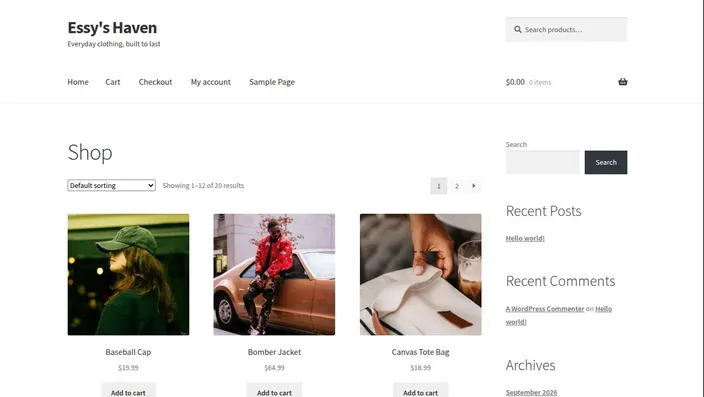
Essy Haven Home Page
Test 1: Real Network Distance From a West African Vantage Point
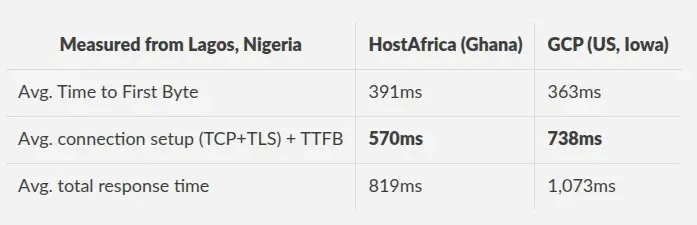
Network distance between Ghana and US
Using Globalping, an open-source, community-run network measurement platform, we sent real HTTP requests to both servers from three independent ISPs in Lagos, Nigeria, the closest available test vantage point to Ghana and one that shares much of the same undersea cable infrastructure serving West African internet traffic.
DNS lookup time was excluded since it mostly reflects resolver caching rather than server location. Connection setup plus Time-To-First-Byte (TTFB) gives us a better indication of how long it actually takes to reach the server.
On that measure, the Ghana-hosted store was roughly 170 ms faster per request, simply from being physically closer to a West African visitor.
Test 2: What Happens When Real Traffic Shows Up?
Distance is only half the story.
Using k6, an open-source load-testing tool, we simulated real shopper sessions: loading the homepage, opening a product page, fetching the cart and adding an item. We then increased concurrent traffic to 20, 40, 60, 80 and 100 simultaneous shoppers.
At light, everyday load, the internationally hosted server was actually faster. More raw compute will usually win when there’s no congestion.
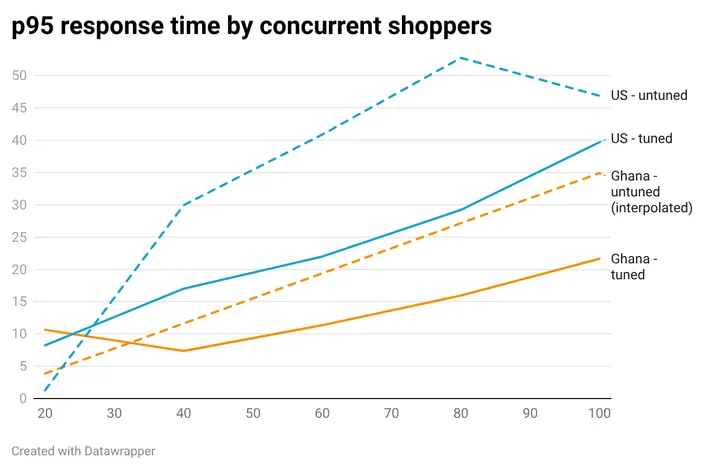
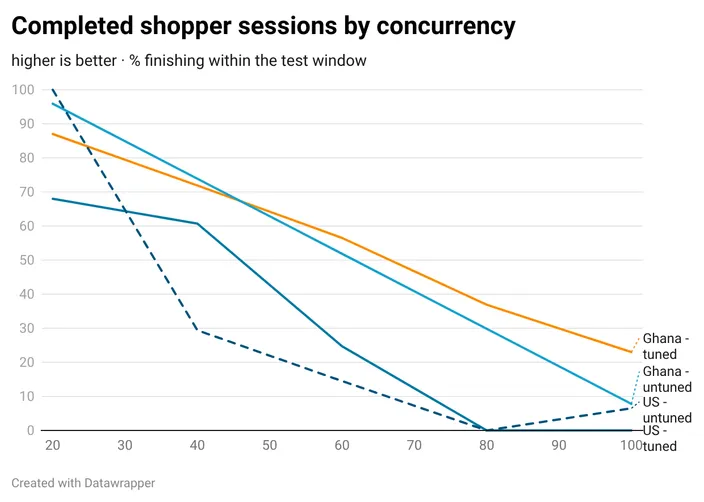
But the moment real-world conditions showed up, a promotion, flash sale or mobile money rush during a live event, the picture reversed.
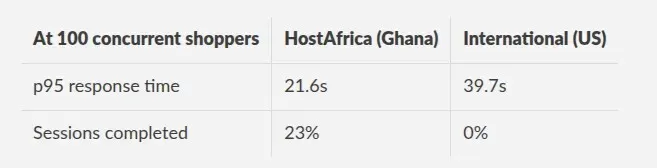
By 80 concurrent shoppers, the internationally hosted store had a 0% session completion rate. Every simulated shopper was still stuck loading a page when the test ended.
The Ghana-hosted store, even on its default, unoptimised configuration, was still completing 37% of sessions at that same load.
% completed sessions between Ghana and US
What This Means for Your Store
Put plainly: the exact scenario that costs Ghanaian stores sales, a promotion, mobile money rush or sudden spike in interested buyers, is also where poor infrastructure performance can hurt the most.
A store hosted overseas isn’t necessarily just a little slower for Ghanaian customers on a quiet Tuesday. Under heavy traffic, that additional distance can become one more bottleneck at exactly the moment you need your store performing at its best.
The scale here isn’t small. As of June 2026, Ghana had 26.4 million active mobile money accounts out of 84.6 million registered accounts, showing just how normalised mobile money has become.
In April 2026 alone, Ghanaians moved GH₵493.2 billion through mobile money across 967 million transactions, and by June they were holding a record GH₵40 billion in wallet balances, up 38% year-on-year.
That confirmation prompt your checkout waits on isn’t an edge case. It’s part of the payment experience millions of Ghanaian consumers already use.
Ghana’s e-commerce market itself generated an estimated $1.007 billion in revenue in 2025, growing 10–15% year-on-year, on top of 26.3 million internet users and 71.8% smartphone penetration nationally.
More people are shopping online in Ghana every year. The infrastructure question is whether stores can serve them properly when they show up.
Why Ecommerce Hosting in Ghana Can Make a Difference
Hosting closer to your customers helps close the network-distance gap measured in our experiment. Just as importantly, choosing the right infrastructure can help your store cope more gracefully when a normal shopping day suddenly becomes a very busy one.

Response time comparing local hosting to overseas hosting
The Ghana side of our experiment ran on HostAfrica infrastructure in Accra, the same local hosting advantage we set out to test, using infrastructure available to Ghanaian businesses and agencies today.
If most of your customers are in Ghana, choosing local infrastructure means putting your website closer to the people actually using it.
That doesn’t mean local hosting magically fixes every ecommerce performance problem. Your website optimisation, database, plugins, caching and available server resources all matter too.
But our experiment demonstrates something much simpler: where your server sits on the map can make a measurable difference.
If you run a Ghanaian online store, the lag your customers complain about isn’t necessarily something to shrug off. When your server is thousands of kilometres away, network distance becomes another obstacle between your customer and a completed purchase.
Hosting locally doesn’t fix everything. But it can remove one of those obstacles, and when your next promotion takes off, that’s precisely when you’ll be glad you did.
